

Masao Yamamoto | Negative Space
“Between a full frame and a quiet thought.”
Masao Yamamoto (山本昌男), born in Gamagori, Aichi Prefecture in 1957, is a Japanese photographer who lives and works in the forested mountains of Yamanashi. He trained initially as a painter — a background that shows in the way his photographs are composed less around the subject than around what surrounds it. His prints are small, palm-sized, handled and aged by hand: toned, stained, creased, worn at the edges until they carry the quality of objects found rather than made. He presents them in loose, scattered groupings in which the spaces between prints are as deliberate as the prints themselves. He describes his role as "nature's messenger" — a phrase that sounds modest until you understand how radical a position it actually is.¹
His two defining series — A Box of Ku and Nakazora — are named for related but distinct Japanese concepts. Ku (空) translates as emptiness or sky, a central Zen Buddhist term for the absence of fixed, independent existence. Nakazora (中空) is more specifically spatial: the space between sky and earth, the empty air, an internal hollow. Where ku describes a philosophical condition, nakazora describes a location — a suspension between states, neither here nor there, the interval before resolution arrives. Together they define the territory Yamamoto works in: not the subject, but the field in which the subject exists and from which it cannot be separated.
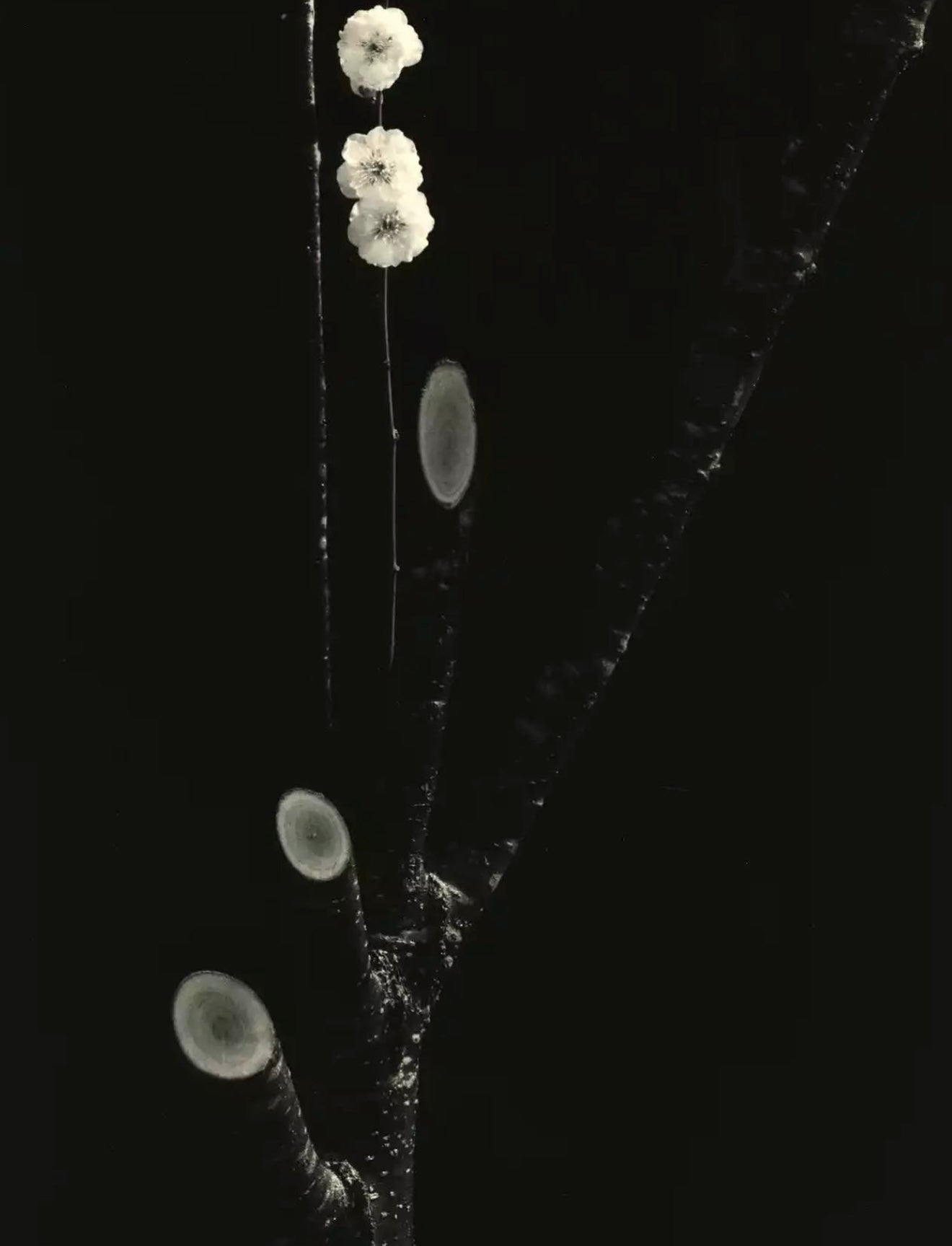
"Bonsai #4026," 2019
Emptiness
The mistake is to read Yamamoto's negative space as absence. It is a different kind of presence — one that only becomes visible when the more insistent presences have been removed. He isolates a single subject against an expansive, textured ground: a stone, a leaf, a resting bird, a figure at the edge of dissolution. The ground is not backdrop. It is the other half of the image, carrying as much weight as the subject it surrounds. The relationship between the two is what the photograph is actually about.
"Kawa=Flow #1692," 2021
This draws directly from the tradition of classical Chinese and Japanese ink painting, where vast blank areas are not compositional convenience but philosophical statement — the smallness of the particular thing against the immensity of the field in which it exists. What Yamamoto adds is the physical object itself. His prints are not windows onto a world. They are things in the world — small, imperfect, aged, held in a hand. The emptiness in the image and the worn edge of the paper it is printed on are continuous. The photograph's incompleteness extends into its own materiality.
Object
The physical process is where Yamamoto's practice becomes most distinctive. Each print is individually toned, stained, and creased by hand — a labor that is not restoration but construction. He is not aging the print to suggest antiquity. He is giving it a body. A surface that records handling, that carries the evidence of having been held. The resulting object has the intimate quality of something found in a drawer — a photograph from a life you do not quite recognize but feel you have lived in.
This is not nostalgia manufactured through technique. It is a specific argument about where meaning lives. The image is not sufficient on its own. It needs the object that carries it — the weight, the temperature, the particular give of paper that has been worked and handled — to complete its effect. What you hold matters to what you see. The print becomes an aged object in the photographic medium: its meaning deepens through contact, through the accumulation of handling over time.
Space
In installation, Yamamoto extends the logic of the single print into the room itself. Prints are presented in loose, scattered groupings — pinned, laid, leaned — at varying heights and distances. The spaces between them are as considered as the prints. A viewer moving through the installation moves through a field of intervals, each one charged with the same quality of suspension the images themselves describe. Nakazora (中空) is no longer just a title. It is the experience of the space.
"Nakazora Installation F-173," 2023
This is where the comparison to haiku (俳句) becomes precise rather than decorative. A haiku is not a short poem. It is a poem in which the compression is the argument — where what is omitted creates the pressure that makes what remains resonate. The kireji (切れ字), the cutting word that divides the haiku into two parts, does not connect those parts so much as hold them apart, creating the interval in which the poem's meaning actually lives. Yamamoto's installations work by the same principle. The space between two prints is the kireji — the cut that activates both. Remove the interval and the prints become a collection. Preserve it and they become a conversation.
This is the most radical dimension of his practice and the least discussed. Yamamoto is not making photographs and then installing them. He is making a spatial argument about how attention moves — how the eye travels from presence to absence and back, how the pause between two things can carry as much meaning as either thing alone. The installation is a score for a particular quality of looking. The viewer who moves through it slowly, who allows the spaces to register, completes the work. The viewer who moves through quickly sees only the prints.
Stance
Living in the forested mountains of Yamanashi, Yamamoto sees his role as "nature's messenger." It is a humble worldview — one in which humans are a small part of a vast, silent whole, and the photographer's task is not to impose meaning but to catch it passing. His negative space embodies this: an ancient, tranquil pond of existence. And his photographs capture a ripple on its surface — a momentary gaze, the sound of water — before it dissolves back into calm.
"Kawa=Flow #1660"
"Kawa=Flow #1558"
It is a world filled with information presented through the art of subtraction.
The emptiness he creates is an open vessel: a space for contemplation that feels both deeply personal and universally resonant. What Yamamoto ultimately proposes is that the most evocative images are not the ones that show everything, but the ones that leave room for the viewer to complete them — personal in the intimacy of each encounter, universal in the silence they share.
"Kawa=Flow #1533"


