Agnes Martin | What Repetition Reveals
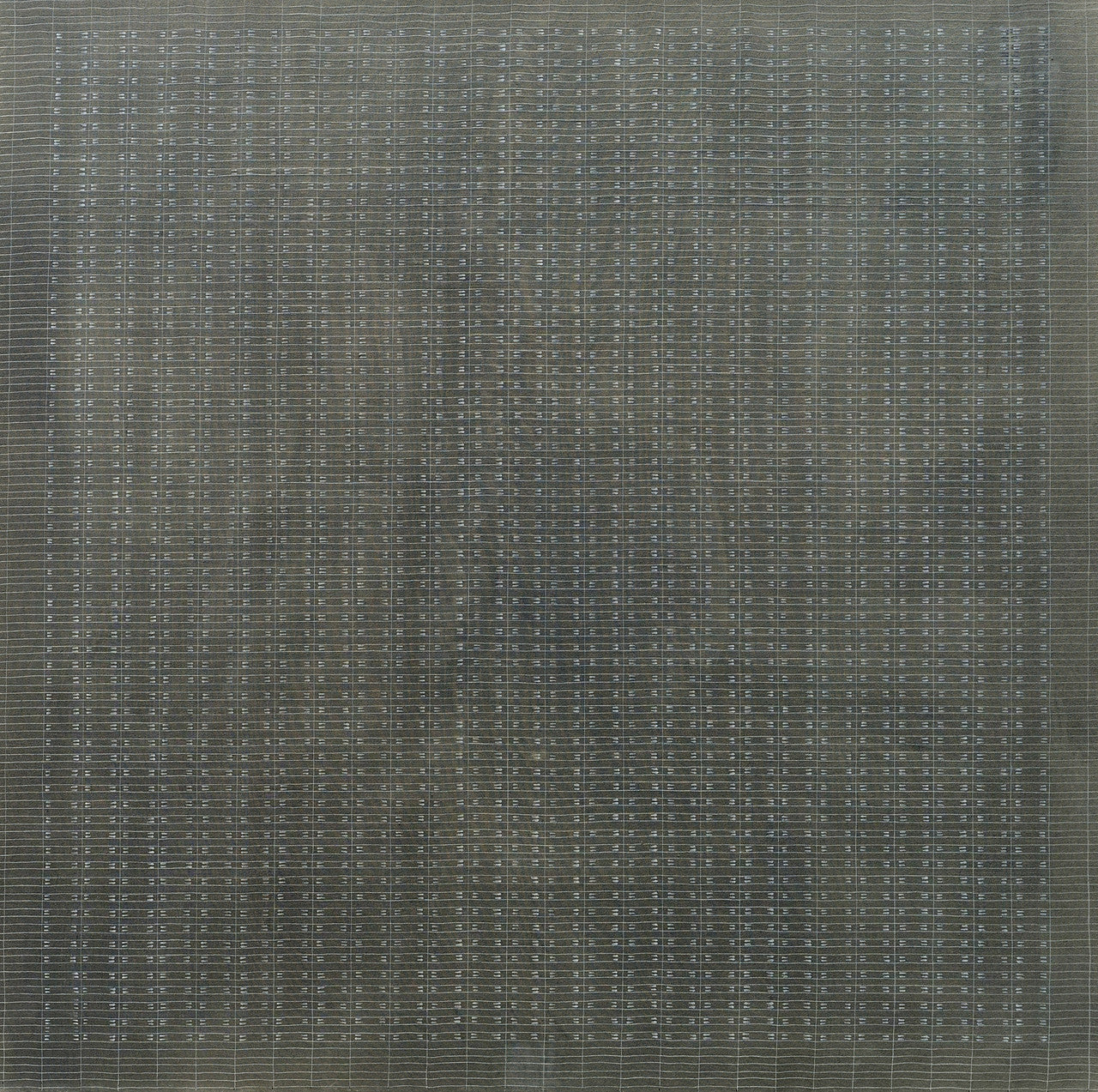
Friendship, 1963. Six feet square. Gold leaf and graphite on canvas. The first thirty seconds reveal a surface — pale, nearly uniform, almost nothing. Then something shifts. A slight tremor in a line. The breath held between one stroke and the next. The places where the hand lifted and returned. A field of hand-drawn marks, none measured by a ruler, accumulating into something that feels, inexplicably, like being seen.

"Friendship," Agnes Martin, 1963
It takes time. Not incidentally — as a condition.
Agnes Martin (1912–2004) was born in Saskatchewan, Canada, and spent the decisive decades of her career in New York before leaving abruptly in 1967 for a tract of land in New Mexico, where she lived and worked in near-solitude until her death at ninety-two. Most often described as a minimalist, a label she consistently rejected. Her work, she insisted, was not of formal structure but of specific emotional states — happiness, innocence, beauty — so quiet they required complete stillness to perceive. "Beauty is the mystery of life," she wrote. "It is in the mind, not in the eye."¹
Grid
Her signature surface: the hand-drawn grid. Six-by-six foot canvases covered in dense, minute graphite lines, horizontal bands of diluted acrylic and pencil, fields of barely differentiated tone hovering at the edge of visibility. The grid functions not as a formal decision but as a container — a structure just sufficient to hold what she was trying to hold, the most delicate, most easily dispersed qualities of inner experience, without imposing its own meaning over them.
The repetition carries no mechanism. Each line marks a separate decision to continue. Martin described her process as waiting — sometimes for days or weeks — for a complete image to arrive in her mind, then executing it at scale exactly as she saw it. Results that failed her she destroyed without hesitation. What remained was only the work in which the inner state and the surface had become, for the duration of the making, the same thing.²

"Untitled from On a Clear Day," Agnes Martin, 1973

"Summer 1964," Agnes Martin, 1965
The grid records what the label "minimalism" misses. The lines are not reduced — they carry the specific quality of attention Martin brought to each one. A line drawn with complete presence and one drawn without it are not the same line; the canvas knows the difference, and the viewer who looks slowly enough begins to know it too. The neuroscience of figure/ground perception offers a partial explanation: Martin's deliberately low contrast and softened edges deny the brain its usual shortcut — the eye cannot stabilize what is figure and what is ground, cannot file the surface and move on. Sustained attention is not a choice the viewer makes. It is built into the surface.³ The paradox sustains itself: the grid — the most impersonal structure available to a painter, repetitive, systematic, seemingly without authorship — turns out to be the most demanding. The repetition does not distance Martin from the work. It holds her inside it.
Permanence
Martin wrote: "Art is the concrete representation of our most subtle feelings."⁴ The word concrete demands attention. Not images of feelings, not symbols, not illustrations of an emotional concept — feelings made concrete, the most fleeting and difficult-to-name interior states given a physical form that would persist. A six-foot canvas of hand-drawn lines outlasts the morning she drew them in. The happiness she aimed to depict — not the idea of happiness but the actual quality of that specific state on a specific day in a New Mexico studio — lives in the surface long after the day has gone.
Most paintings represent something external: a landscape, a figure, an event, an idea. Martin's paintings represent something existing only in the interior, impossible to photograph or describe or point to, that would otherwise leave no trace. She was solving the problem of how to make the invisible permanent — not by naming it but by giving it a body.

"Little Sister," Agnes Martin, 1962
Moment
Other artists arrive at permanence differently — not through the accumulation of deliberate marks, but through the irreversibility of making itself. The material moves, and then it does not. What it holds in that transition is the record.
Kenichi Sasakawa works in molten glass — a material of extreme volatility, responsive to breath, heat, and the speed of the hand in ways that clay and stone resist. The fine bubbles suspended throughout each of his vessels record that volatility: air caught at the instant the glass still moved, preserved the moment it cooled. Each bubble marks a moment of making made permanent. The surface of a Sasakawa vessel does not represent its own creation — it is the creation, frozen.

Where Martin's graphite lines record an inner state — the specific quality of her attention on a specific day — Sasakawa's suspended bubbles record something both more physical and more contingent: the exact conditions of a particular act of making. The temperature of the furnace, the breath that shaped the gather, the speed of the rotation, etc. No two pieces emerge identically not because Sasakawa pursues variety but because the conditions of making never repeat. Each vessel remains unrepeatable in the way each moment remains unrepeatable — not by design, but by necessity.
The permanence does not end at the making. What Martin fixed in graphite stays fixed — the inner state she captured on the day she drew it remains exactly as she left it. Sasakawa's bubbles keep producing new moments long after the making concludes. As light moves through the day — morning light low and raking, midday direct and flat, afternoon warm and oblique — the bubbles catch it differently. A bubble invisible at nine becomes a point of refracted light at three. The vessel placed on a desk this morning differs subtly from the same object this evening. It does not record one moment. It generates new ones, in the specific light of the specific room, at the specific hour of whoever lives with it.
The making is fixed. The living with it is not. The glass remembers how it was made. The light does not, arriving freely, caught by the bubbles, shown through the vessel in the most literal sense, new.
Solitude
Martin left New York in 1967 without announcement, drove west, and spent years building her own adobe house in New Mexico before returning to painting. She urged aspiring artists: "A studio is not a place in which to talk to friends. You will hate your friends if they destroy the atmosphere."⁵ For the last fifty years of her life, she read no newspaper.

"Portrait of Agnes Martin in New Mexico," Charles R. Rushton, 1992
Not eccentricity — a precise understanding of what her work required. Work about the most subtle feelings cannot survive alongside noise competing for the same interior space. The withdrawal was the practice. Solitude was not a condition she endured in order to paint but the condition the painting depended on — the only environment in which the signals she was trying to receive remained audible.
A parallel runs through Sasakawa's commitment to a studio practice in Kyoto where each piece passes through his hands alone, and his refusal of industrial production. The scale of commitment differs. The logic holds. What both protect: the quality of presence the work requires — and that the work, when it succeeds, transmits.
Surface
Martin wrote that all her paintings were the same painting — always attempting to depict the same thing, the endless repetition not repetition at all but an endless approach toward something that kept receding as she advanced.⁶ The grid remains the same. The surface differs every time, because she differed every time, and the surface knows.

"Portrait of Agnes Martin in New Mexico," Charles R. Rushton, 1992
This separates a surface made with full presence from one made without it — not the visible mark of the hand, though that figures into it, but the quality of attention present during the making, somehow retained in the mark. It cannot be faked or replicated. Either there or not, and the person who looks slowly enough will know.
Martin's paintings demand that presence. Sasakawa's vessels demand it differently: not the long looking of a six-foot canvas, but the noticing of what the light does at this particular hour, in this particular room, today. The inner state made permanent. The moment kept arriving. Two different answers to the same question: what does it mean to make something fully alive?
¹ Agnes Martin, lecture transcript, cited in Guggenheim Museum audio transcript, Agnes Martin Speaks About Emotion and Art.
² Agnes Martin: Paintings, Writings, Remembrances, ed. Arne Glimcher, Phaidon, 2012.
³ Fraser, R., "A Shimmering Thing at the Edge of Analysis: Figure/Ground and the Paintings of Agnes Martin," International Journal of Arts in Society, 2013; Dia Art Foundation catalogue, Agnes Martin: A Field of Vision, Paintings from the 1980s.
⁴ Agnes Martin, Writings, ed. Dieter Schwarz, Cantz Verlag, 1991, p. 15.
⁵ Agnes Martin, handwritten notes for student lecture, cited in The Marginalian, 2016.
⁶ Agnes Martin, interview, cited in Artnet News, 2018.