Article: Visiting | Atelier Fesseler
Visiting | Atelier Fesseler
Frederic Fesseler makes writing instruments by hand, in woods chosen for their grain and temperament. He works at his atelier in Berlin, which he inherited from his father — a furniture restorer, sculptor, mask maker, and much more.

Your father restored furniture, and you watched him work from a very young age. What did you pick up from him, skills or more?
A lot of things, perhaps best described as the essence of the practice. From the technique to the work ethic: attention to detail, especially to the finish, and the standard one holds oneself to. It’s like learning a language, you know? Part of it lives in the body, and part of it is manners.

Do you see your work as a departure from your father’s, or a continuation?
A continuation. I’m carrying something on. He restored furniture, and he was a sculptor too; I mainly make pens. Of course there’s a connection. It’s not the same product, but in the end it’s the same approach to how you work. Just a different medium.
His masks are everywhere in here. Do you look at them while you work?
Many times, in the middle of work. For me it’s a little break. They’re theater masks; he used to make them for Bernhard Minetti. Looking at them feels like traveling, like daydreaming into another lifetime. Two artistic worlds connecting.

So why writing instruments? Did you write or draw a lot before?
I wanted to become a painter when I was fifteen, and I like drawing with the sketching pencil or the fountain pens now. But I have to answer honestly: back then, painting had no influence on the pens. What I find beautiful in writing instruments is that making one is like constructing a house, miniature architecture really. With small objects, I can really sharpen my skills as an artisan. The perfect, brilliant finish. A simple, minimal form, and the capacity to bring out the beauty of the wood. It sounds a bit kitsch, but it really is simple: the beauty of the material.
And working by hand, when so much is made by machines, where did that come from?
My studies. I studied product design in Barcelona, and there we had to do everything on the computer, rendering, and CAD. Unfortunately, I’m not good at it. I like to work with my hands, with colors. It looks chaotic, but to me, that chaos is good.
Almost everything is typed now. What do you think the significance of writing instruments has become?
At the end of the day, I think pens are still needed. Well actually, especially in this age — when everything is moving to digital. A pen is not really an object of practicality anymore. Well, it will always be useful, but it holds more symbolic weight now. When you sit somewhere with a pen instead of your phone, you are more there. You look around, you notice things. It keeps you in the moment. So it’s a deliberate choice. An attitude, a way of living.

When you write, what’s the part you love: thinking with the pen in hand or drawing the line itself?
When I am thinking and holding the pen. These instruments are companions to thought. The more refined they are, the more you feel accompanied and supported. It nourishes the mind.
You’ve worked with so many woods: easy ones, stubborn ones, grain you have to study for a long time. Are they more like friends or rivals?
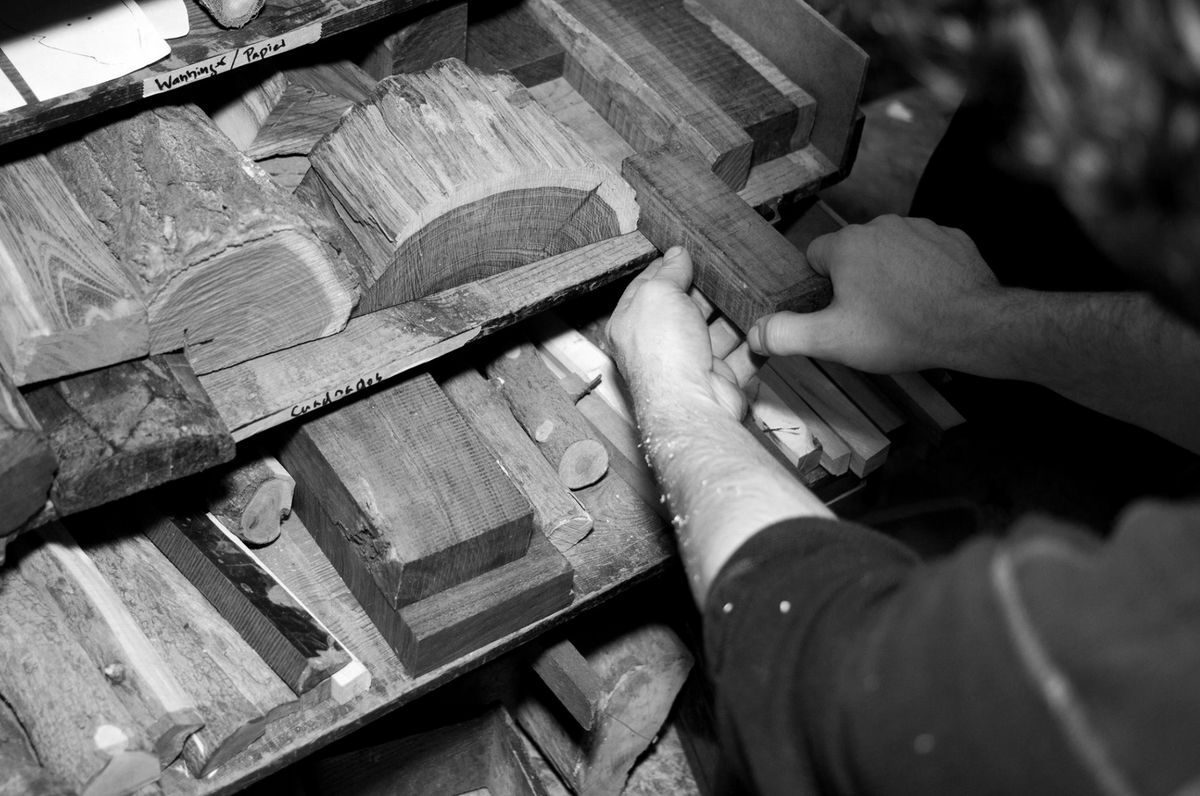
Friends, of course. We have to give them respect. Each wood has a personality that echoes the people drawn to it, and in the end each wood finds its owner. But it’s a friend you need patience with. If you’re not patient enough, when you’re nearly finished and arriving at the tip of the pen, sometimes it chips, and you have to start over. You have to understand how each wood is different. Some are easy to work; others are really tricky. Snakewood is absolutely beautiful, but so tricky to work with.
It sounds like a childhood friend almost. You know their habits, what sets them off, who they go quiet around.
It’s a love drama, really (chuckled).

And if you had to choose a favorite type of wood?
Grenadilla, the black one. It’s traditionally used for fine wind instruments, like flutes.
There’s a purity to it, a sense of enduring beauty.

“Companions to thoughts.”